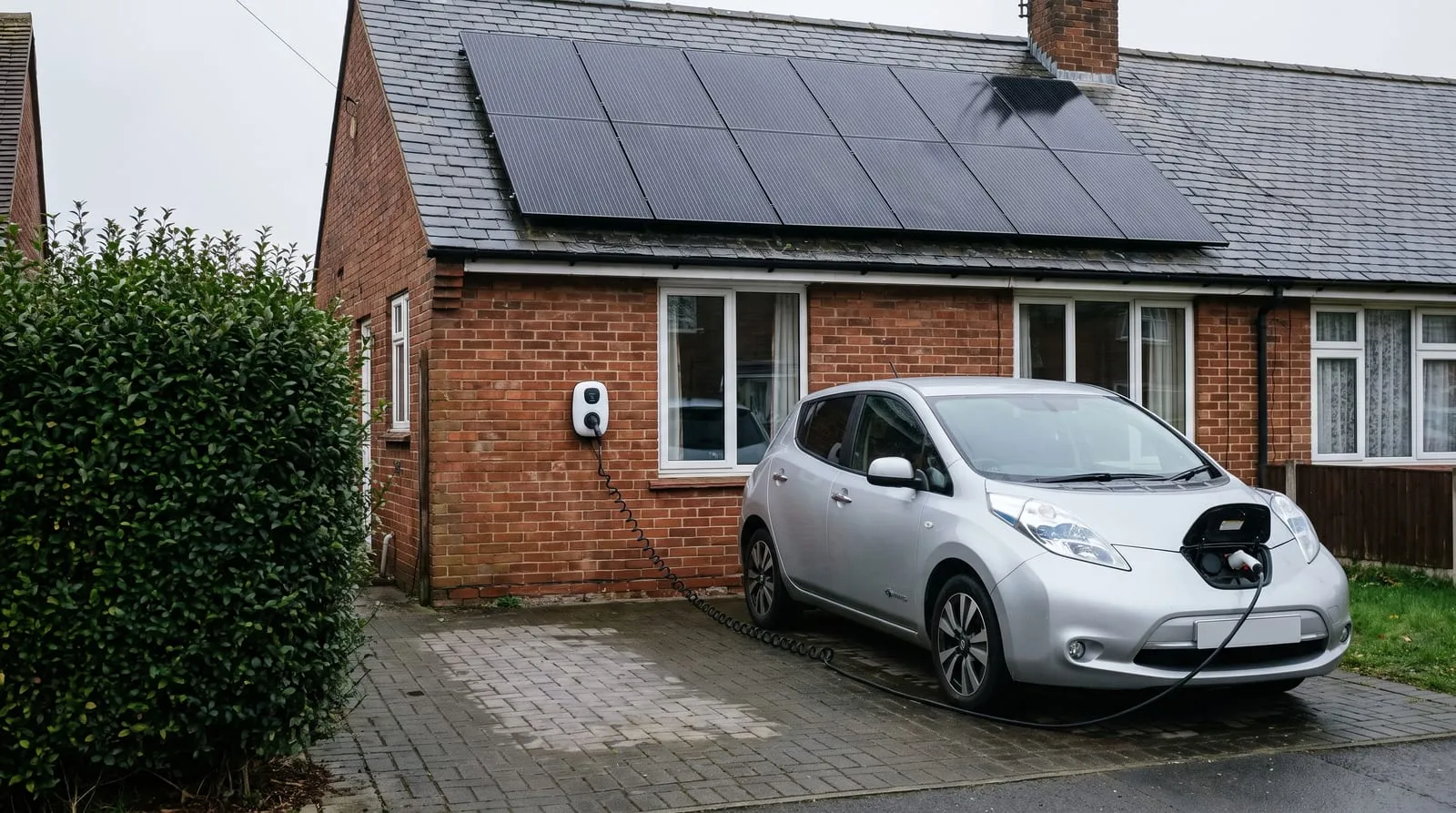
How much of an EV's charging solar can realistically cover, why timing matters more than total output, and what a battery adds to the equation.
Adding an electric car to a house roughly doubles its electricity demand, which is exactly why so many EV owners start looking at solar. The honest answer is yes: solar can charge a car, and the annual arithmetic works better than most people expect. The catch isn’t how much your roof generates. It’s when it generates it.
The annual numbers stack up
A modern 460W panel in the North West produces roughly 330–400 kWh a year depending on aspect and pitch. A twelve-panel array is therefore somewhere around 4,000–4,800 kWh over twelve months.
Most electric cars return between 3 and 4 miles per kWh in real UK driving, worse in winter. At 8,000 miles a year (a fairly typical annual mileage), that’s about 2,000–2,700 kWh of charging.
So on paper, a mid-sized array generates more than enough to cover a year’s driving with plenty left over for the house. On paper.
Why timing is the real problem
Solar generates in the middle of the day. Cars are frequently somewhere else in the middle of the day, and when they are on the drive, the sun often isn’t out.
Every unit you generate and don’t use gets exported instead, earning around 12p under the Smart Export Guarantee. Every unit you later pull back off the grid to charge the car costs around 24p. Export at 12p, import at 24p, and you’ve handed roughly half the value of that unit to your supplier.
That’s the whole problem in one sentence, and it’s why “can solar charge my car” is really a question about matching, not generation.
Three ways to close the gap
Charge during daylight. The simplest fix, and free. If someone’s home in the day, or the car sits on the drive at weekends, plugging in at 11am rather than 11pm changes the economics completely. Most EV chargers and car apps let you schedule this, and solar-aware chargers go further by modulating the charge rate to track what the panels are actually producing.
Add battery storage. This is what makes solar and an EV genuinely work together for people who commute. The battery banks midday generation and releases it in the evening when the car comes home. A 10 kWh battery holds enough for a meaningful chunk of a typical overnight charge, and batteries are stackable from 5 kWh up to 60 kWh if your driving is heavier than average.
Use a smart tariff alongside it. EV tariffs with a cheap overnight window let you top up the car, and refill the battery, at well below the standard rate on dark winter days. Solar carries the summer, the tariff carries the winter, and the battery is what lets you play both.
Does an EV change how you size the system?
Yes, in both directions. An EV pushes you toward the upper end of the panel count (16 to 20 panels rather than 10) because you have somewhere useful to put the extra generation instead of exporting it at 12p. Twenty panels with a 10 kWh battery starts from around £10,000.
It also strengthens the case for a battery. Without a car, a battery mainly shifts household evening use. With a car, it has a second job and gets worked harder, which shortens the payback.
Solar payback in the UK typically lands in the 5–8 year range, and a household that self-consumes more of what it generates sits at the better end of that. An EV, used sensibly, is one of the most effective ways to raise self-consumption there is.
What to check before you commit
Your existing consumer unit and incoming supply matter if a charger and a solar system are both going in. So does the position of the charger relative to the inverter and battery, because it affects cabling and where the kit can sensibly live. These are survey questions, not spreadsheet questions.
Panels will generate for 25 years or more, so it’s worth designing the system around the driving you’ll actually be doing, not just this year’s mileage.
If you’re running an EV or about to, our free, no-obligation survey will model what your roof can realistically cover and what a battery adds on top, with no pressure either way.
Want to know if this is right for your home?
Our design proposals are free and carry no obligation. We cover all of England.
Get a free quote today