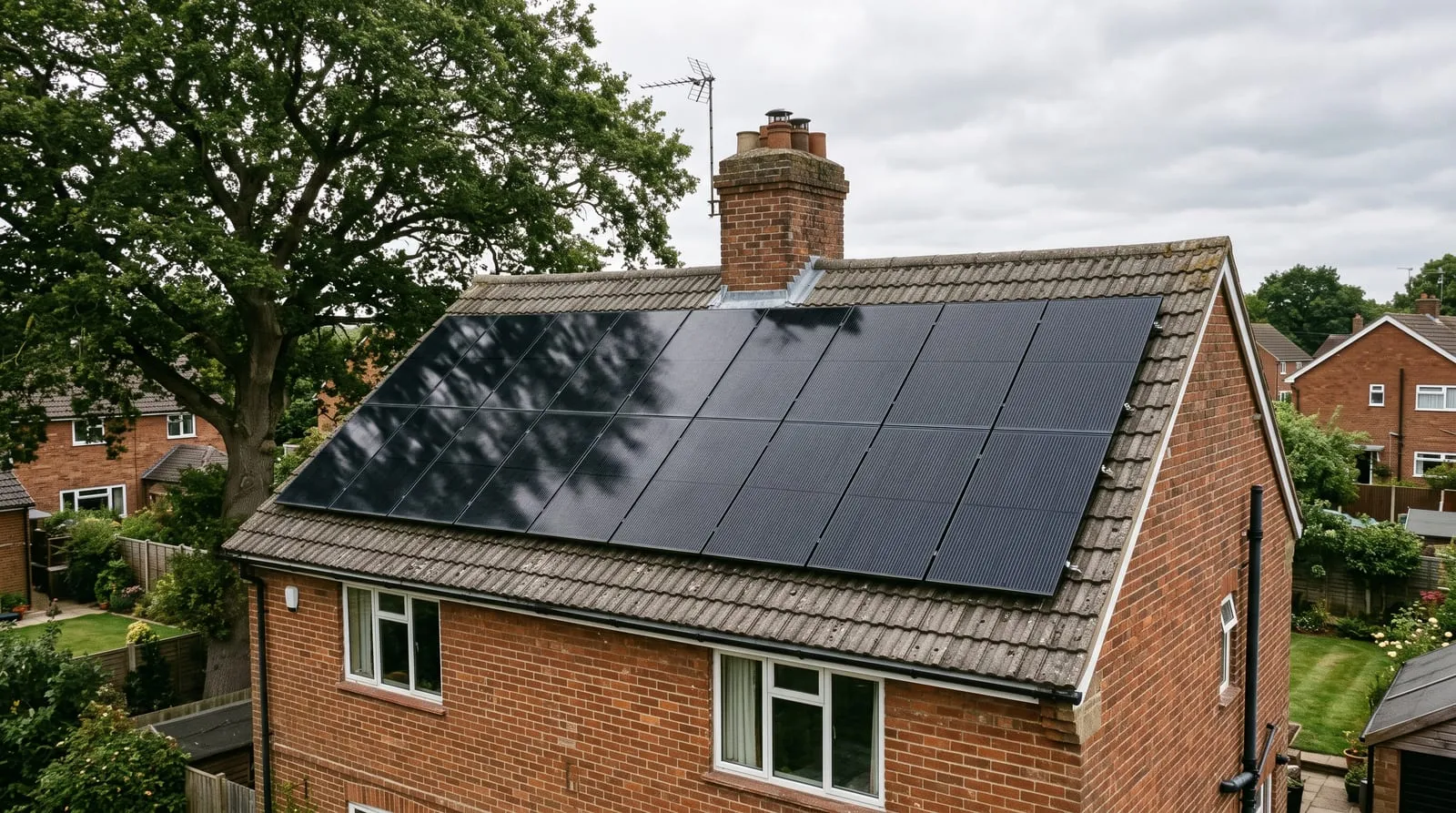
Chimneys, trees and neighbouring roofs don't rule out solar. How shading actually affects output, and when optimisers are worth paying for.
Shading is the single most common reason people talk themselves out of solar before they’ve had anyone look at the roof. A chimney, a tall sycamore two gardens over, a neighbour’s gable end: it feels like a dealbreaker. In practice it very rarely is, but shading does need to be designed around properly rather than ignored, and the way it’s handled makes a real difference to what the system produces.
Shade doesn’t switch a panel off
A shaded panel doesn’t stop working, it works less well. Panels generate from diffuse light as well as direct sunlight, which is why systems still produce meaningfully on an overcast day in Wigan in November. Partial shade reduces output rather than eliminating it.
The bigger issue isn’t the shaded panel itself, it’s what that panel can do to the ones connected to it. Panels in a string are wired in series, and in the simplest arrangement the weakest panel can drag down the current flowing through the whole string. That’s the origin of the old warning that “one shaded panel kills your array”. It was a fair description of systems built two decades ago. It’s a poor description of a well-designed modern one.
What’s changed
Every panel we install (Trina, JA Solar, DMEGC) has bypass diodes built into it. These let current route around the shaded section of a panel instead of being throttled by it, so the loss is contained to part of one panel rather than propagating down the string. That alone handles a lot of light, intermittent shading.
Beyond that, there are three broad design approaches:
String design. The cheapest and often the most effective fix is simply not putting shaded and unshaded panels on the same string. If the two panels nearest the chimney are the problem, they can go on a separate string or a separate MPPT input on the inverter, so the rest of the array is unaffected by them. Modern hybrid inverters from FoxESS and Sigenergy have multiple MPPT trackers precisely so this can be done.
Power optimisers. These are small devices fitted behind individual panels that let each one operate at its own optimum point regardless of what its neighbours are doing. They add cost per panel and another set of components on the roof, but on a genuinely awkward array they recover output that string design alone can’t.
Microinverters. These take it further, converting DC to AC at each panel. They’re the most tolerant of shading and the most expensive per panel, and they change the system architecture: worth discussing if you’re also planning battery storage, since it affects how that’s wired in.
When optimisers are actually worth it
Honestly? Less often than they’re sold. Optimisers are worth paying for when shading is persistent, moves across the array through the day, and affects panels that can’t be cleanly separated onto their own string (a chimney stack mid-roof is the classic case). They’re much less compelling when the shading is early-morning or late-evening only, when it hits panels at one end of the array that can simply be strung separately, or when it’s a seasonal issue you’d rather solve with a tree surgeon.
If a quote adds optimisers to every panel on a completely clear south-facing roof, ask why. On a clear roof they add cost and complexity without adding much output.
Getting the survey right
This is the part that can’t be done from satellite imagery. Shading changes through the day and across the seasons: the sun sits much lower in December than in June, so a boundary hedge that’s irrelevant in summer can shade the bottom row of panels for hours in winter. Working out how much output that actually costs you over a year, and whether it justifies optimisers, is a physical survey job.
It also feeds back into sizing. If two panels in a 12-panel layout are compromised, the answer might be to shift the layout, drop those two positions, or add a couple elsewhere to make up the generation. Our systems typically run from 6 to 20 panels at 460W each, and there’s usually more flexibility in the layout than people assume.
The short version
Shade reduces output; it doesn’t rule out solar. Bypass diodes, sensible string design and, where genuinely justified, optimisers mean most shaded roofs still make a solid system with a payback in the usual 5–8 year range. What matters is that whoever designs it has actually stood on your drive and looked at where the shadows fall.
If you’ve been assuming your roof is too shaded to bother, our free, no-obligation survey will tell you exactly how much it costs you and what the sensible design response is, before you spend anything.
Want to know if this is right for your home?
Our design proposals are free and carry no obligation. We cover all of England.
Get a free quote today