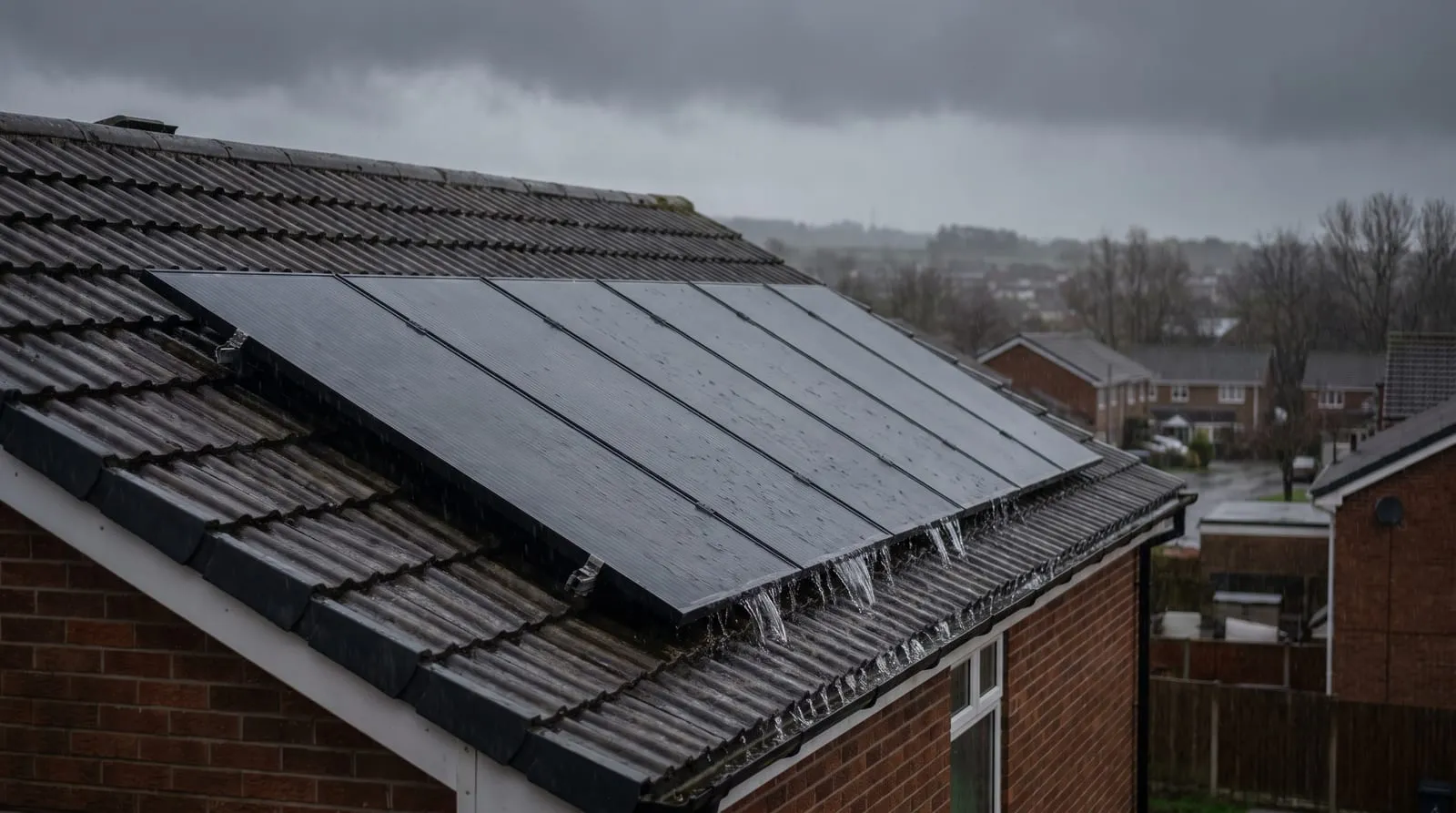
Manchester gets more rain than Rome, and solar still pays. What grey skies, rain and northern latitude actually do to solar generation in the North West.
We install solar panels in Wigan, Manchester, Liverpool and across the North West: statistically some of the greyest, wettest corners of England. So let’s answer the question every customer asks with a smile: does solar actually work here?
Yes. Here’s the evidence.
Panels run on daylight, not sunshine
Solar panels generate from light, not heat or direct sunbeams. On an overcast day a system still produces 10–25% of its peak output; on a bright-but-cloudy day, 40–60%. What matters is the total light energy landing on your roof across a whole year, and the North West receives around 850–950 kWh per square metre annually. That’s less than Cornwall’s ~1,100, but only by 15–20%, not the 50% people imagine.
The numbers for a real system
A well-sited 4.4kWp system in Greater Manchester or Lancashire typically generates 3,400–3,900 kWh per year, close to the average home’s entire annual electricity usage. Generation skews toward summer, which is why pairing panels with a battery matters more up here: it shifts surplus daytime power into the evenings, keeping self-consumption high even with our weather.
Cool weather is actually a small advantage
Panel efficiency drops as panels get hot: output falls roughly 0.3–0.4% for every degree above 25°C. The North West’s mild summers mean panels here spend more time in their ideal operating range than panels in southern Europe. Rain has an upside too: it washes dust and pollen off the array, keeping output up without maintenance.
What about winter?
December and January are genuinely lean (perhaps 3–5% of annual generation each). No installer should tell you otherwise. But a smart tariff plus battery fills the gap: charge cheaply overnight, run the house from the battery through peak hours, and let the panels take over again from February. Our designs model the full year, lean months included, so the payback figure you see in your quote reflects reality.
The proof is on the roofs
The strongest argument is empirical: solar has been paying for itself across the UK for years, with payback of 5–8 years typical here in the North West, on North West weather. Germany, hardly a sun-drenched country, runs one of the largest solar fleets on Earth at similar latitudes to ours.
Grey skies are a design consideration, not a dealbreaker. If your roof is worth putting panels on, our free survey will show you the numbers for your actual house, rain included.
Want to know if this is right for your home?
Our design proposals are free and carry no obligation. We cover all of England.
Get a free quote today