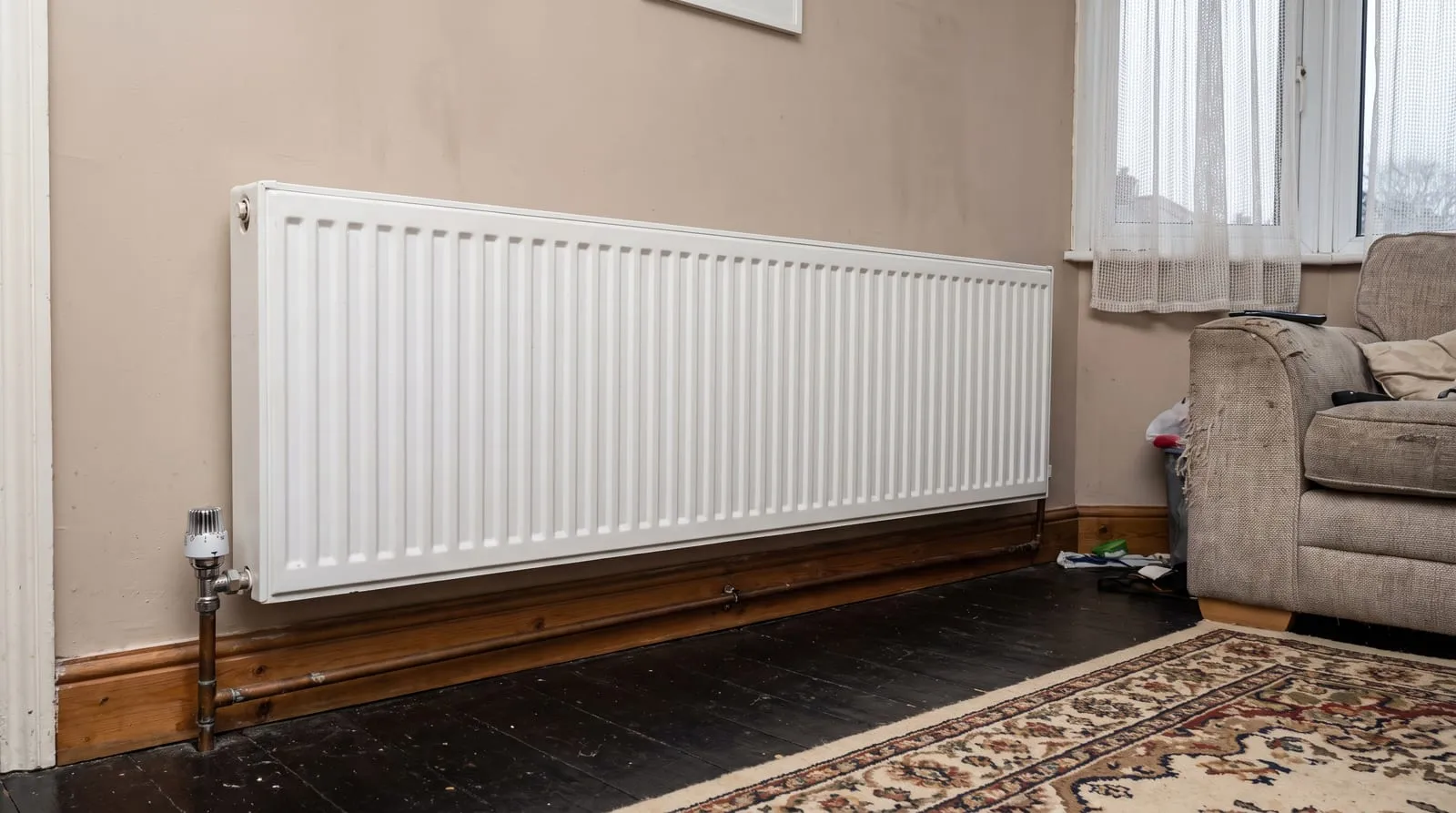
The honest answer to whether your radiators need replacing for a heat pump: when they're fine, when they need upgrading, and what it costs.
“Will I need to rip out all my radiators?” comes up on almost every heat pump survey we do. The honest answer is sometimes, and it depends on physics that’s easy to explain once you see it laid out.
Why the question comes up at all
A gas boiler typically heats water to 70–80°C before sending it round your radiators. A heat pump works best running “flow temperatures” of 35–45°C. Lower flow temperature is exactly what gives a heat pump its high efficiency (SCOP): the compressor works less hard to lift heat from the outside air when it only needs to raise water to a modest temperature.
The catch is basic thermodynamics: a radiator sized for 75°C water gives out roughly half as much heat when fed with 40°C water instead. So the question isn’t really “do heat pumps need bigger radiators”: it’s “does this room’s radiator still put out enough heat at a lower flow temperature to keep the room warm on the coldest day of the year.”
When your existing radiators are fine
More often than homeowners expect, nothing needs to change. This is common when:
- The room is already well insulated (cavity wall insulation, decent loft insulation, double glazing)
- The existing radiator was oversized to begin with, which is very common in UK homes, where radiators are often chosen by “what looked right” rather than a proper calculation
- You’re happy running the heat pump at a slightly higher flow temperature (say 45–50°C rather than 35°C): you lose a little efficiency but keep every radiator as it is
A proper room-by-room heat loss survey (which every heat pump quote we issue starts with) calculates the actual heat loss in watts for every room, checks it against the output of the radiator already fitted, and tells you precisely which rooms pass and which don’t. No guesswork, no “just replace everything to be safe.”
When you do need changes
The rooms that typically need attention are the ones with small, old single-panel radiators trying to heat a poorly insulated space: a Victorian bay-windowed lounge, an uninsulated extension, or a large room with a radiator sized for a much smaller space. In these cases there are usually three options, roughly in order of cost:
- Add a second radiator panel or fins to an existing radiator, often the cheapest fix, boosting output without a full replacement
- Upgrade to a larger radiator, typically a double-panel, double-convector (K2) type in the same footprint or slightly bigger
- Move to underfloor heating in that room: the lowest possible flow temperature and highest comfort, usually only practical during a renovation or extension since it means lifting the floor
For most three-bed semis we survey, this means upgrading somewhere between two and five radiators out of ten or twelve, not a whole-house replacement.
What it adds to the job
Because the Boiler Upgrade Scheme grant (£7,500, or £9,000 for oil and LPG homes) is claimed by the installer and taken off the price upfront, radiator upgrades are simply added to the overall quote rather than being a separate expense to budget for. A handful of radiator swaps typically adds a few hundred pounds to the job; underfloor heating in a single room costs more and is usually planned alongside other renovation work rather than bolted onto a heat pump install on its own.
The installation itself doesn’t take noticeably longer for a couple of radiator swaps: our heat pump installs typically run 2–3 days regardless, with radiator work folded into that window.
The mistake to avoid
The costly mistake isn’t skipping a radiator upgrade you needed, it’s the opposite: an installer who upgrades radiators (or worse, quotes a bigger heat pump) without ever doing a heat loss calculation, “just to be safe.” That approach both overspends your budget and often oversizes the heat pump itself, which hurts efficiency and comfort in the long run. The heat loss survey is what tells you the truth, room by room, rather than a rule of thumb.
The bottom line
Some radiators may need upgrading, most won’t, and a proper survey tells you which is which before you commit to anything. If you’re weighing up a heat pump and want to know exactly where your home stands, book a free, no-obligation survey and we’ll walk every radiator with you and show you the numbers.
Want to know if this is right for your home?
Our design proposals are free and carry no obligation. We cover all of England.
Get a free quote today